

Zeolite rotary concentrator
Zeolite rotary concentrator is a device designed to reduce the volume of air that needs to be cleaned of VOCs by concentrating very low concentrations of VOCs from large volumes of air into a small fraction of air with a high VOC content. It is an adsorption system using a special rotating zeolite wheel that allows for the economical treatment of huge air flows with a minimal content of organic substances. The concentrator itself does not completely remove VOCs – it serves to concentrate pollutants, to which a smaller thermal or catalytic oxidation unit (TNV, RTO or RCO) is then connected.
Do you have any questions or would you like to collaborate?
Write to us and we will get back to you shortly.
HOW DOES IT WORK?
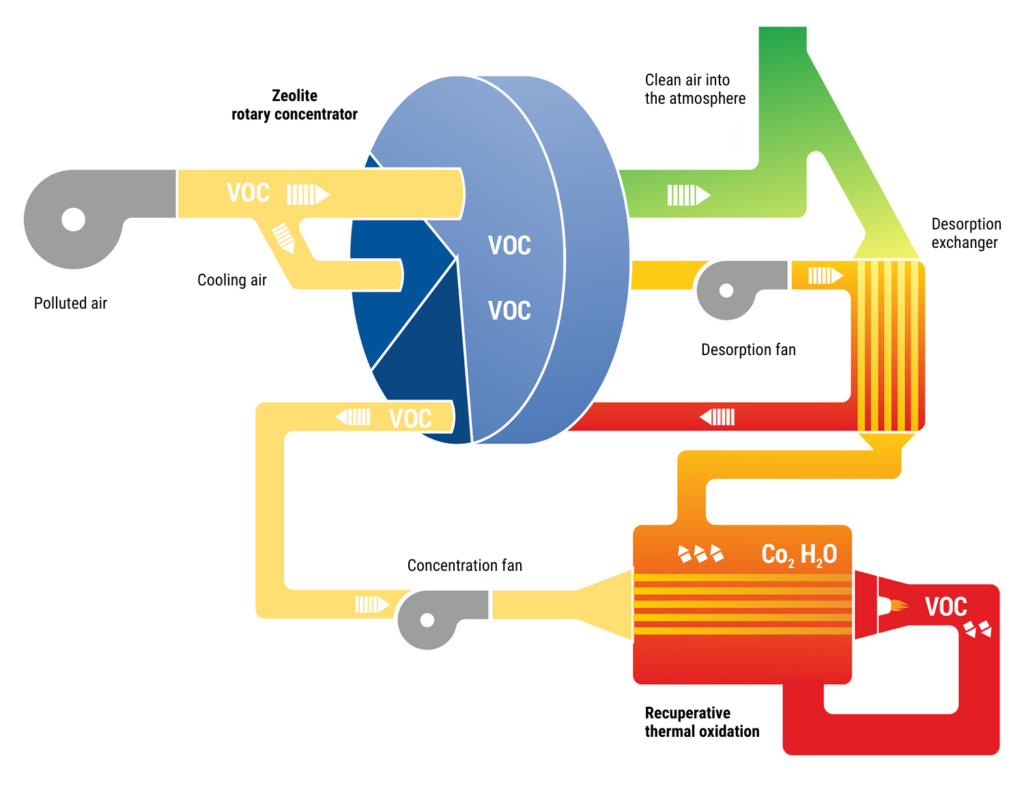
A large volume of polluted air is fed by a fan into a rotating adsorption rotor covered with a zeolite sorbent. The rotor is divided into three sectors: the adsorption section (approx. 80% of the area), the desorption section and the cooling section. In the adsorption section, the contaminated air flows through a porous zeolite layer, which captures (adsorbs) the VOCs contained therein.
The purified air, free from VOCs, then exits into the chimney – the efficiency of VOC capture on the rotor is usually around 95%. The absorbed organic substances gradually accumulate in the zeolite, which rotates towards the desorption zone. Before the desorption itself, the zeolite is cooled in a smaller cooling section by a stream of clean air – this ensures that the sorbent can withstand thermal stress and at the same time increases the efficiency of the subsequent desorption. Then, a stream of hot air (typically with a temperature of 180–200 °C) enters the desorption section, which displaces the VOCs from the sorbent. This desorption air with a high concentration of VOCs (in the order of g/m³) is then fed to a downstream combustion unit – either thermal or catalytic oxidation – where the VOCs are definitively destroyed to CO₂ and H₂O. The heat generated by the combustion of VOCs in this unit is partly used to heat the desorption air in the exchanger and to preheat the polluted air if the system operates in a closed circuit. Thanks to the zeolite concentrator, the volume of air entering the more expensive combustion technology is dramatically reduced – often to less than 10% of the original volume – which means that the subsequent oxidation can be carried out in a much smaller and cheaper unit with lower fuel consumption.
Key benefits:
-
Possibility of cleaning huge volumes of air: The concentrator allows for the economical handling of flows in the order of tens to hundreds of thousands of m³/h by dividing them into a small concentrated stream and a large purified stream. Without it, the purification of such diluted emissions would be disproportionately expensive.
-
High efficiency of VOC capture: The zeolite rotor removes around 95% of VOCs from the air passing through it on the first pass. The concentrated stream contains virtually all pollutants and can then be burned with high efficiency in a suitable oxidizer.
-
Lowest operating costs in the area: In the range of very low concentrations (tens to hundreds of mg/m³), the zeolite concentrator has no competition in terms of cost.
-
Minimizes energy consumption Only a small desorption stream is heated, while most of the air passes through the system without the need for heating. This drastically reduces the fuel consumption of the entire cleaning process.
-
Low investment costs for subsequent oxidation: Thanks to the VOC concentration, the subsequent thermal/catalytic incinerator can be designed significantly smaller. This means a lower purchase price for the complete solution per m³ of purified air.
-
Safety and durability: The zeolite sorbent is a non-flammable ceramic material, so there is no risk of fire as with competitors with activated carbon. In addition, zeolite rotary concentrators are designed so that the sorbent can withstand years of operation without significant loss of efficiency - the long life of the zeolite minimizes the cost of replacing the sorbent.
-
Flexibility: The system handles fluctuations in concentration and flow rate – in the event of a sudden increase in VOC, the concentration in the desorption stream temporarily increases, which is safely disposed of by the subsequent incinerator. It is also possible to modulate the rotor speed or desorption temperature according to the current load, which gives a lot of room for optimization.
-
Design: Compared to activated carbon, a zeolite sorbent can be designed and manufactured specifically for a given pollutant, or a mixture of them, resulting in significantly higher adsorption efficiency.
Typical use:
Zeolite concentrators are used at sources where VOCs are very diluted (typically 0.05–0.5 g/m³), but the total volumes of extracted air are huge – for example in large paint shops, dryers, in the production of composites (lamination), during surface cleaning and ventilation of operations, etc. A typical example is automotive paint shops: a large amount of ventilation air contains only trace amounts of solvents.
Without a concentrator, it would be necessary to burn hundreds of thousands of m³/h of air, while with the device, the concentrated flow is reduced to a fraction of this volume. However, the concentrator needs to be protected from extremes – high humidity, dust or aerosols that would clog the sorbent. Therefore, upstream filtration and drying devices are often placed in front of it if the air contains a lot of moisture or particles. In combination with subsequent oxidation, the zeolite rotary concentrator represents a top solution for reducing VOCs emissions, especially in sectors where direct combustion would not be effective due to the huge volume of air.


